


Olival Suncream Spf 30
Olival Suncream Spf 30
Product Description
Product overview
Face sunscreen with SPF 30 broad-spectrum UV protection from chemical and mineral filters. Olive oil and cocoa butter provide occlusive hydration, while ascorbic acid and glycerin support moisture retention and skin barrier function. Lightweight lotion texture absorbs quickly without greasy residue, suitable for daily layering.
Dual-filter UV system with antioxidant support
This sunscreen combines octocrylene and butyl methoxydibenzoylmethane (avobenzone) for broad-spectrum protection, paired with titanium dioxide for additional UVA coverage. The formula adds stabilized vitamin C (ascorbic acid) to neutralize free radicals generated by sun exposure.
Texture & feel
SENSORYBroad-spectrum SPF 30 protection
Octocrylene and butyl methoxydibenzoylmethane work synergistically to block UVB and UVA rays, with titanium dioxide reinforcing long-wave UVA defense. This multi-filter approach reduces cumulative photodamage during daily outdoor exposure.
Plant-oil hydration layer
Olea europaea (olive) fruit oil and theobroma cacao seed butter form a breathable occlusive barrier that reduces transepidermal water loss. These lipids are quickly absorbed and leave skin feeling soft without a waxy finish.
Vitamin C antioxidant boost
Ascorbic acid penetrates the skin barrier to neutralize oxidative stress caused by UV exposure and environmental pollutants. This strengthens the skin's natural defense against photodamage and supports collagen maintenance.
Glycerin humectant core
Glycerin at approximately 5% concentration draws moisture into the stratum corneum, enhancing hydration depth. This is especially effective when layered over serums or essences in multi-step routines.
Stable preservative system
Phenoxyethanol and ethylhexylglycerin prevent microbial growth without parabens, maintaining product integrity throughout the jar lifespan. Both are well-tolerated by sensitive skin when used at preservative concentrations.
Lightweight lotion texture
The formula spreads easily without heaviness or pilling, making it compatible with layering over vitamin C serums or under makeup. Silica provides a smooth, non-greasy finish that sets quickly on application.
Safety & compatibility
SAFEBoth octocrylene and avobenzone have been deemed safe during pregnancy by major dermatological bodies when used at sunscreen concentrations. Titanium dioxide adds mineral coverage without systemic absorption.
The INCI list contains no known fungal-acne triggers (malassezia fermentens feeders). Glycerin and plant oils are stable humectants that do not promote yeast proliferation.
Parfum (parfum), hexyl cinnamal, and hydroxyisohexyl 3-cyclohexene carboxaldehyde are included. Individuals with fragrance sensitivity or rosacea may experience irritation; patch-test first.
SPF 30 requires reapplication after 2 hours of continuous sun exposure or immediately after swimming or heavy sweating, even though this formula is not waterproof.
The ascorbic acid in this sunscreen is stabilized enough to layer over acidic vitamin C serums without oxidative conflict, making it suitable for brightening routines.
Paraffinum liquidum (mineral oil) is occlusive but at low concentration and combined with fast-absorbing plant oils. Fungal-acne-safe status confirms no yeast-feeding lipids are present.
Ingredient breakdown
INCIOctocrylene Proven
A UVB filter that absorbs broad-spectrum radiation and converts it into heat. Octocrylene is stable across formulations and enhances the photostability of avobenzone, making the UV system more durable.
- Mechanism: Absorbs UVB (280–320 nm) and stabilizes avobenzone through photochemical resonance
- Function: Allows lower avobenzone concentrations while maintaining efficacy
- Benefit: Reduces need for reapplication frequency compared to single-filter systems
Butyl Methoxydibenzoylmethane Proven
A chemical UVA filter (commonly called avobenzone) that absorbs long-wave UVA radiation (315–400 nm). It is essential for preventing photodamage and photoaging, though it can degrade under sunlight without stabilizers like octocrylene.
- Mechanism: Absorbs UVA1 and UVA2 (315–400 nm), preventing deep dermal collagen damage
- Stability: Octocrylene in this formula stabilizes avobenzone molecules, extending protective duration
- Benefit: Broad-spectrum protection prevents premature aging and dark spots
Ascorbic Acid Proven
Stabilized vitamin C that penetrates skin to neutralize free radicals generated by UV exposure. It strengthens collagen cross-linking and reduces hyperpigmentation, especially when applied before sun exposure.
- Mechanism: Donates electrons to oxidized molecules (free radicals), preventing photodamage cascades
- Function: Supports collagen I synthesis and melanin suppression
- Benefit: Enhanced anti-aging effect when combined with SPF; cumulative brightening over 8–12 weeks
Glycerin Proven
A humectant that attracts water into the stratum corneum, increasing hydration depth. At ~5% concentration, it maintains skin plumpness and supports barrier function without occluding pores.
- Mechanism: Draws moisture from dermis into epidermis through osmotic gradient
- Function: Increases skin hydration and elasticity
- Benefit: Supports barrier repair and reduces transepidermal water loss
Olea Europaea Fruit Oil Supporting
Olive oil provides oleic acid and squalene, which are natural skin lipids. It hydrates and softens the skin barrier while offering light antioxidant support from polyphenols.
- Mechanism: Oleic acid integrates into the lipid bilayer, reducing TEWL
- Function: Emollient and antioxidant (polyphenol content varies by extraction method)
- Benefit: Gentle hydration without clogging; suitable for sensitive and mature skin
Theobroma Cacao Seed Butter Supporting
Cocoa butter is an occlusive emollient rich in stearic acid and polyphenols. It provides lasting hydration and sensory comfort (pleasant scent and smooth texture) while supporting skin barrier integrity.
- Mechanism: Stearic acid and palmitic acid seal moisture in the stratum corneum
- Function: Occlusive emollient with mild antioxidant and anti-inflammatory properties
- Benefit: Softens skin texture and reduces dryness; popular in K-beauty and Western formulas
Titanium Dioxide Supporting
A mineral UVA filter that reflects and scatters UV radiation, primarily blocking UVA2 (315–340 nm). Unlike avobenzone, titanium dioxide is photostable and does not require stabilizers.
- Mechanism: Physical blocking: reflects/scatters UV photons before they reach living skin
- Function: Reinforces broad-spectrum coverage when combined with chemical filters
- Benefit: Non-degradable; maintains efficacy throughout sun exposure without reapplication (though SPF label still requires 2-hour reapplication)
Tocopherol Supporting
Tocopherol (vitamin E) is a fat-soluble antioxidant that protects skin lipids from oxidative stress. It stabilizes other actives (like vitamin C) and strengthens the barrier against photodamage.
- Mechanism: Donates electrons to free radicals, preventing lipid peroxidation
- Function: Synergizes with ascorbic acid to extend antioxidant defense
- Benefit: Reduces erythema and supports collagen preservation
Ascorbyl Palmitate Supporting
A fat-soluble form of vitamin C that penetrates lipophilic skin structures. It provides slower but more stable antioxidant activity than ascorbic acid, complementing the water-soluble ascorbic acid in this formula.
- Mechanism: Converted to ascorbic acid in skin; offers sustained antioxidant coverage
- Function: Extends the anti-inflammatory and brightening window
- Benefit: Combined with ascorbic acid, creates a dual-phase vitamin C system
Phenoxyethanol Supporting
A preservative that prevents bacterial and fungal contamination without parabens. At typical 0.5–1% concentration, it is well-tolerated by sensitive skin and does not disrupt skin microbiome balance.
- Mechanism: Denatures microbial cell membranes, preventing growth
- Function: Broad-spectrum preservation against mold, yeast, and bacteria
- Benefit: Paraben-free alternative with a strong safety profile across regulatory agencies
22 ingredients
Aqua, Octocrylene, Cetearyl Alcohol, Paraffinum Liquidum, Olea Europaea Fruit Oil, Theobroma Cacao Seed Butter, Glycerin, Sodium Cetearyl Sulfate, Butyl Methoxydibenzoylmethane, Titanium Dioxide, Silica, Phenoxyethanol, Ethylhexylglycerin, Tocopheryl Acetate, PEG-8, Tocopherol, Ascorbyl Palmitate, Ascorbic Acid, Citric Acid, Parfum, Hexyl Cinnamal, Hydroxyisohexyl 3-Cyclohexene Carboxaldehyde.
Where it fits in your routine
STEP 06Apply this sunscreen as the final step in your AM routine after all serums, essences, and moisturizers have been absorbed (2–3 minutes). Use a sunscreen-appropriate amount (about 1/4 teaspoon or 2 fingers for the face and neck) to ensure SPF coverage. If layering over a vitamin C serum, wait 5–10 minutes for the serum to set, then apply this sunscreen to lock in actives. Reapply every 2 hours during continuous sun exposure or immediately after swimming, even though water resistance is not claimed.
How to use
5 STEPSApply 15 minutes before sun exposure
Chemical UV filters need 15-20 minutes to bind to the stratum corneum and form an even protective film. Apply at the end of your morning routine after moisturiser has fully absorbed, then wait before stepping outside. Skipping this delay is the single most common reason sunscreen underperforms its lab-rated SPF.
Use enough — two-finger rule
Most users apply only 25-50% of the dose used in lab testing, which slashes real-world SPF. Squeeze two index-finger-length strips of product onto your fingers — this delivers roughly 1.25 g, enough to cover face plus neck at the WHO-recommended 2 mg/cm² density that the SPF rating assumes.
Apply evenly to face, neck, ears, hands
Don't forget the often-missed zones: hairline, eyelids (use a sunscreen-safe formula), tops of ears, sides of neck, and backs of hands. Dot the product across your face first, then spread outward in upward strokes. Patting motions blend better than rubbing and reduce product loss into fingertips.
Wait 60 seconds before makeup
Let the sunscreen film set undisturbed for at least 60 seconds before layering foundation or powder. Apply makeup with patting motions rather than dragging strokes to keep the UV film intact. Avoid blotting papers during the day — they lift product and create unprotected gaps.
Reapply every 2 hours
Reapplication is non-negotiable on any day you're outside, swimming, sweating, or after towel-drying. For touch-ups over makeup, choose a stick or powder format and apply liberally to high-exposure zones (nose, cheekbones, forehead). UVA passes through ordinary window glass, so the 2-hour interval still applies at an indoor desk by a window.
Who is it for?
FIT CHECKPerfect for you if
- You have mature or sun-damaged skin and want antioxidant + UV protection in one step
- You're following a brightening routine with vitamin C serums and need a compatible SPF
- You prefer plant-oil hydration (olive, cocoa) over silicone or polymer bases
- You're pregnant or nursing and need a stable, safe broad-spectrum sunscreen
- You have fungal-acne-prone skin and need a paraben-free, malassezia-safe option
- You layer actives and want a lightweight lotion that doesn't pill or interfere with serums
- You have combination to normal skin with mild dryness and prefer a non-greasy finish
Consider alternatives if
- You need a water-resistant or sweat-proof sunscreen for high-intensity sports or swimming
- You have a severe fragrance sensitivity and cannot tolerate any synthetic parfum
- You're looking for a high-SPF option (50+) — this is SPF 30, suitable for daily incidental sun
- You prefer completely fragrance-free products and want to avoid all aromatic compounds
- You have very oily skin and want a completely matte finish without any emollient base
- You need a sunscreen specifically formulated for sensitive skin with minimal ingredients
Skin type compatibility
6 TYPESOlive oil, cocoa butter, and glycerin create a hydrating, occlusive layer that prevents transepidermal water loss. The lotion texture absorbs quickly without leaving residue, making it suitable for dry skin without clogging.
The plant-oil content and emollients may feel slightly heavy or glossy on oily skin types. A lighter, oil-free sunscreen might suit oily skin better, though the lotion format dries faster than cream options.
The balanced blend of humectants and emollients works well for combination skin. Hydration from glycerin supports dry zones, while the lightweight formula doesn't overload the T-zone.
Paraben-free preservation and a stable UV filter system reduce irritation risk. However, the synthetic fragrance (parfum, hexyl cinnamal) may trigger reactions in fragrance-sensitive individuals; patch-test first.
The formula is fungal-acne-safe with no malassezia fermentens feeders, and the paraffinum liquidum (mineral oil) is at a low concentration. The lotion texture is non-comedogenic when applied in appropriate amounts.
Ascorbic acid and ascorbyl palmitate provide dual-phase antioxidant support to prevent photodamage and support collagen. The plant-oil hydration addresses fine lines, while the avobenzone + titanium dioxide system prevents cumulative photoaging.
Results timeline
WEEK 8+Hydration boost and smooth texture
Glycerin and plant oils immediately improve skin hydration and softness. The lotion absorbs quickly, leaving a comfortable, non-greasy base for makeup or other actives.
Users frequently noticed improved skin softness within the first weekVisible barrier strengthening
Consistent daily use of the occluding plant oils and vitamin E reduces visible dryness and flakiness. Skin tone becomes more even as ascorbic acid begins to work on hyperpigmentation.
Users frequently reported reduced dryness and more even texture by week 3Brightening and photodamage reversal
Ascorbic acid and ascorbyl palmitate accumulate in the epidermis, reducing dark spots and dullness. The dual-filter UV system prevents new photodamage, while antioxidants neutralize existing sun-induced free radicals.
Users frequently noticed visible brightening and reduced hyperpigmentation by week 8Long-term anti-aging support
Consistent vitamin C + SPF use stimulates collagen synthesis and reduces fine lines. The avobenzone and titanium dioxide prevent future photodamage, supporting cumulative skin resilience and firmness.
Users frequently reported firmer, smoother skin and reduced visible signs of photoaging at 12 weeksRatings by platform
3.1K+ REVIEWSPros & cons
BALANCEDPraised
- Dual vitamin C system (ascorbic acid + ascorbyl palmitate) offers stable, cumulative brightening
- Broad-spectrum SPF 30 with avobenzone + octocrylene + titanium dioxide prevents photodamage
- Plant-oil base (olive, cocoa) hydrates dry skin without silicones or heavy polymers
- Paraben-free and fungal-acne-safe, suitable for sensitive and reactive skin types
- Lightweight lotion texture absorbs quickly without pilling under makeup or serums
- Pregnancy-safe UV filtration approved by major dermatological regulatory bodies
- Glycerin + emollients support barrier repair and reduce transepidermal water loss
- Suitable for layering in multi-step AM routines with serums and essences
Criticized
- Synthetic fragrance (parfum, hexyl cinnamal) may trigger irritation in fragrance-sensitive users
- SPF 30 is suited to daily incidental sun exposure, not high-intensity outdoor activities
- Not waterproof — requires reapplication after swimming or heavy sweating
- Plant-oil content may feel slightly heavy or glossy on very oily skin types
- Jar packaging may limit shelf life compared to pump or tube formats
- Subtle white cast from titanium dioxide may be noticeable on deeper skin tones at full strength
- Contains paraffinum liquidum (mineral oil), which some prefer to avoid on oily or acne-prone skin
Budget-friendly alternatives (dupes)
DUPES
K-beauty hybrid sunscreen with rice bran extract, glycerin, and chemical + mineral filters (similar dual-filter approach to Olival). However, Relief Sun offers SPF 50+ coverage and is fragrance-free, making it better for sensitive skin despite a slightly heavier texture.

Western drugstore option with avobenzone, titanium dioxide, and glycerin for hydration. CeraVe's formula includes ceramides instead of plant oils, offering comparable UV protection at a lower price — trade-off is less antioxidant support (no vitamin C).

K-beauty hydrating essence (not a sunscreen) that shares glycerin and plant extract focus but offers no UV protection. It complements Olival in a layered routine but cannot replace it; better for users seeking an additional hydration step before sunscreen.

Affordable humectant-based moisturizer with glycerin and amino acids for hydration, but contains no UV filters. Best used as a layering step under Olival or another sunscreen; does not provide sun protection on its own.
Comparison with competitors
SIDE-BY-SIDE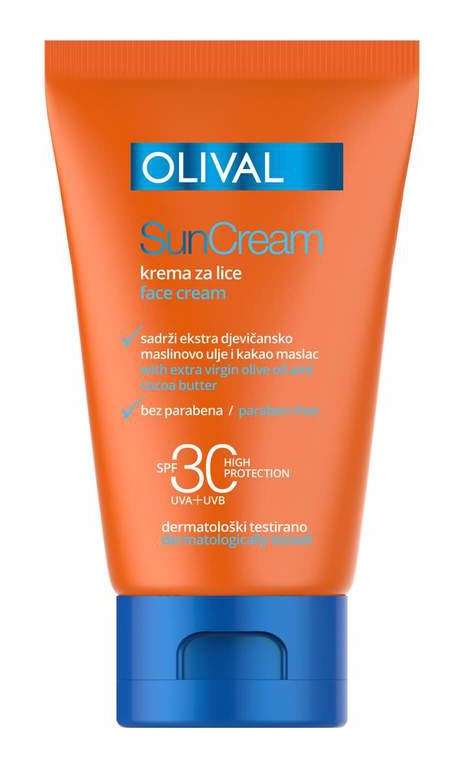
Olival — Suncream SPF 30

Storage & shelf life
12 MONTHS12 months after opening. Check the small jar symbol on the packaging for the manufacturer-specified PAO. Some brands also print a manufacture date — keep both in mind.
Store in a cool, dry place away from direct sunlight. Avoid leaving in a hot car or direct heat — sunscreen actives degrade above 35°C / 95°F. Keep the cap on when not in use.
Standard cosmetic packaging with cap. Re-cap after each use to prevent oxidation of actives.
Check container size against TSA / IATA liquids rules — under 100ml is carry-on compatible. Use a leak-proof travel pouch.
Frequently asked questions
FAQYes. Both avobenzone and octocrylene are classified as safe for use during pregnancy by the American Academy of Dermatology and FDA. Titanium dioxide adds mineral coverage without systemic absorption. The formula contains no retinoids, hydroquinone, or other category X ingredients. Dermatologists commonly recommend this sunscreen profile (chemical + mineral hybrid) to pregnant patients. Always consult your OB-GYN if you have specific concerns.
Yes. The INCI list contains no known malassezia fermentens feeders (esters, fatty acids, polysorbates with problematic lipid profiles). Glycerin and plant oils are stable humectants that do not promote yeast growth. Paraffinum liquidum (mineral oil) is at low concentration and does not trigger fungal-acne flares in most users. Patch-test on a small area first to monitor tolerance.
Apply your vitamin C serum (e.g., L-ascorbic acid or stabilized derivative) to clean, damp skin and wait 5–10 minutes for full absorption. Then apply this sunscreen using a sunscreen-appropriate amount (~1/4 teaspoon for face and neck). The ascorbic acid and ascorbyl palmitate in the sunscreen will amplify antioxidant defense. Do not apply sunscreen immediately after the serum, as the additional water content can dilute the serum's efficacy.
This product comes in a 50 ml jar. With proper sunscreen application (1/4 teaspoon twice daily for face and neck), this size lasts approximately 3–4 weeks. Jar packaging may expose the formula to light and air, potentially reducing vitamin C stability over time compared to pump or tube formats. Store in a cool, dark place away from direct sunlight.
No. The INCI list does not include water-resistant silicones or polymers. This sunscreen requires reapplication every 2 hours during continuous sun exposure and immediately after swimming, sweating, or towel-drying. For water activities or intense exercise, choose a dedicated water-resistant or sport sunscreen (typically labeled 'water-resistant 80 minutes').
Titanium dioxide contributes a subtle white cast, especially at SPF-recommended amounts (thick application for full coverage). This is more noticeable on deeper skin tones. If this bothers you, apply the sunscreen in two thin layers rather than one thick layer, or blend it gently into the skin. Alternatively, switch to an avobenzone-only formula if you prefer minimal white cast.
Yes. The lightweight lotion texture dries to a satin finish and is compatible with most foundations, cushions, and powders. Allow 2–3 minutes for the sunscreen to set before applying makeup to prevent pilling. Some users prefer setting the sunscreen with a translucent powder to mattify the finish and reduce any shine, especially on combination skin.
The formula contains parfum (fragrance), hexyl cinnamal, and hydroxyisohexyl 3-cyclohexene carboxaldehyde. While these are standard cosmetic fragrance compounds, individuals with rosacea, fragrance sensitivity, or contact dermatitis should patch-test first. If you have a documented fragrance allergy, skip this product and choose a fragrance-free alternative (e.g., CeraVe SPF 30 or Beauty of Joseon Relief Sun).
Verdict: Olival Suncream SPF 30 is a hybrid chemical-mineral sunscreen that combines avobenzone, octocrylene, and titanium dioxide for stable broad-spectrum UV protection. The dual vitamin C system (ascorbic acid and ascorbyl palmitate) provides measurable antioxidant support, while olive oil and cocoa butter deliver plant-based hydration suitable for daily layering. This formula is pregnancy-safe, fungal-acne-safe, and paraben-free, making it accessible to users with common sensitivities or restrictive routines. The lightweight lotion texture absorbs quickly without greasiness, though the jar packaging exposes the formula to light and air more readily than pump formats. The synthetic fragrance, while pleasant, may irritate fragrance-sensitive users. This sunscreen is best suited for mature or dry skin types with brightening goals, or for anyone seeking a hydrating, antioxidant-rich SPF 30 for daily indoor and outdoor use within a multi-step AM routine.
Product Overview

 What are Quick Product Notes?
Quick product notes are a great way to check if a product is free from commonly avoided ingredients by skincare enthusiasts. These preferences come about for different reasons depending on the ingredient such as personal experiences, sensitivities, health preferences & etc.
 Pro Tip Alert!
Just because a product is not free from a common preference does not mean it's a bad product! You can make a personal decision whether or not you want to use a product that contains these ingredients or not - click the labels of the preference to read more about them.
Quick Product Notes
 Paraben-Free
Paraben-Free
Paraben-Free
Understanding Parabens
Parabens are a large group of preservatives which are used to prevent bacteria growing in cosmetic formulations. There has been some healthy controversy surrounding them due to a few studies finding paraben presence in breast tumours and breast tissue. However, the majority of the scientific community have deemed these findings non-conclusive due to the limitations of these studies. There's still a lot of support for avoiding parabens following the better safe than sorry route. If you do we completely support you! If you are concerned about the health safety of parabens, then feel free to avoid them by looking out for the Paraben-Free icon. If not, don't worry about it - they do have had one of the longest safety records as preservatives!
Which Ingredients are classified as Paraben?
A product will be paraben-free if it does not contain any of the following parabens:
- Sodium Isobutylparaben
- Sodium Ethylparaben
- Sodium Butylparaben
- Propylparaben
- Isopropylparaben
- Isobutylparaben
- Sodium Propylparaben
- Butylparaben
- Ethylparaben
- Sodium Methylparaben
- Methylparaben
Sulfate-Free
Sulfate-Free
Understanding Sulfates
Sulfates are a large group of ingredients which act as cleansing agents in Cosmetics. They help loosen up the dirt and grime from your skin and hair to allow for water to wash it away with ease. However some sulfates are so good at their job, they can wash off your skin’s own natural oils that keep it moisturised and protected which can lead to dryness and irritation. Most people will find no issues with sulfate, however if you find your skin doesn't like sulfates then free feel to avoid them by looking out for the sulfate-free icon on Skincarisma.
Which ingredients are classified as sulfates?
We've taken the Sulfates which are considered more harsh for our Sulfate-Free status. A product will be Sulfate-Free if it does not contain any of the following Sulfates:
- TEA-Dodecylbenzenesulfonate
- Ammonium Laureth Sulfate
- Sodium Lauryl Sulfate
- PEG-15 Cocamine
- Sodium Laureth Sulfate
- Sodium Cocoyl Sarcosinate
- Sodium C14-16 Olefin Sulfonate
- Dioctyl Sodium Sulfosuccinate
- Ammonium Xylenesulfonate
- Ammonium Lauryl Sulfate
- Sodium Xylenesulfonate
- Sodium Myreth Sulfate
- Sodium Lauryl Sulfoacetate
Alcohol-Free
Alcohol-Free
Understanding Simple Alcohols
Alcohol ingredients are widely used in cosmetics and come in different types. For the most part alcohols are not problematic at all. However one type of alcohols, simple alcohols can be quite drying to the skin because it evaporates very quickly. This can cause irritation which can also lead to other skin complications. These alcohols should never be used alone on your skin, but combined with other cosmetic ingredients, they are normally without issue. However, for some people with sensitive and easily irritable skin, avoiding products with these simple alcohols may be beneficial. If you find your skin doesn't like these simple alcohols, then free feel to avoid them by looking out for the Alcohol-Free icon.
Which Ingredients are classified as Alcohol?
A product will be alcohol-free if it does not contain any of the following alcohol ingredients:
- SD Alcohol
- Alcohol Denat
- Isopropyl Alcohol
- Alcohol
Silicone-Free
Silicone-Free
Understanding Silicones
If you've ever used a skincare, makeup or beauty product that's made your skin look and feel smoother tempoarily - it's likely contained Silicone. They are a popular class of ingredients found in cosmetics due to their smooth, soft, easy-to-spread and smooth properties that help creates an artificial layer/barrier on top of skin or hair (commonly found in conditioners).
For the same reasons they are popularly used, they are also commonly avoided. Anecdotally, many individuals have reported that Silicones cause/excerbate breakouts, irritation, cause a feeling of skin being unable to breathe, cause clumping of cosmetic products and find it difficult to wash off. As a result, those who find them problematic are avoiding them and increasingly, cosmetic companies are avoiding them as well.
If you have had bad experiences with Silicones in the past, or suspect they are problematic then look out for the tick on the Silicone-free label.
Disclaimer
The Silicone-free label only includes the most common Silicone ingredients that have indentified been reported by individuals that could potentially cause issues.
These include: Amodimethicone, Behenoxy Dimethicone, Bis-Aminopropyl Dimethicone, Cetearyl Methicone, Cetyl Dimethicone, Cyclomethicone, Cyclopentasiloxane, Dimethicone, Dimethicone Copolyol, Dimethiconol, Methicone, Phenyl Trimethicone, Phenyl Trimethicone, Stearoxy Dimethicone, Stearyl Dimethicone, Trimethylsilylamodimethicone.
Note, that this does not include all ingredients part of the Silicone class of ingredients.
EU Allergen-Free
EU Allergen-Free
Understanding the Identified Contact Allergens
The EU's Scientific Committee on Consumer Safety (SCCS) has identified and established 26 cosmetic ingredients that are likely contact allergens (potential to cause skin allergies) as demonstrated in clinical or epidemiological studies. The EU's SCCS have recommend cosmetic companies to disclose them on the labels if used and in cases where the concentration exceeds 0.001% in leave-on products and 0.01% in rinse-off products, then they must be labelled.
Look out for the tick on the EU-Allergen free label to know your cosmetic is free from any of the 26 identified cosmetic ingredients.
For more information regarding the EU's Scientific Committee on Consumer Safety, please visit their official website.
Disclaimer
The EU Allergen Free label is for the 26 ingredients identified by the EU SCCS and products will be only flagged if a suspected ingredient is on it's ingredient list. It is possible for cosmetics to contain one of the suspect ingredients without it appearing on the ingredient list due to it not reaching the concentration threshold to disclose it and cosmetic manufacturers choice to not disclose it.
Also note, the EU Allergen Free label is not personalized for your own allergies you may have and it does not constitute as medical advice. For your specific case, always consult your medical professiona such as dermatologist, physician, pharmacist, or health care provider - please read our medical disclaimer for more information.
Fungal Acne (Molassezia) Safe
Fungal Acne (Molassezia) Safe
Understanding Fungal Acne (Pityrosporum Folliculitis/Malassezia Folliculitis)
Pityrosporum Folliculitis/Malassezia folliculitis or simply known as Fungal Acne is a persistent acne-like condition that commonly responds poorly to traditional acne-treating methods. Unlike most cases of Acne where bacteria is the culprit, Fungi is the culprit of Fungal Acne (Hence the name!). There are certain classes & groups of ingredients that have been shown to promote and feed the growth of the Fungal Acne, Fungi such as fatty acids, oils, esters, polysorbates and fermented ingredients.
For more information regarding Fungal Acne, please visit Simple Skincare Science (f.c) - #3 of our Recommend Skincare Resources for an amazing comprehensive guide!
Please Read: How to use the Fungal Acne (Malassezia) Label
At SkinCarisma, we've done our best to identify as many ingredients as possible but note the fungal-free label may not be 100% accurate due to the complexconditions and combination of ingredients that malezzeria can thrive on.
Additionally, products that may contain ingredients that have shown to feed Malassezia may not neccessarily exacerbate the condition due to concentration of ingredient used in the product, this information is simply not available on the products.
As a result, please note this is only an experimental label that can be best used to possible identify problematic products you have used in the past. It is in no way a perfect identifier nor a predictor in whether or not it will exacerbate or cause fungal acne. It will continue to be worked on as more information and research comes to light.
If you find any ingredients you believe should be included, please email us at snails@skincarisma.com.
Disclaimer
Due to the lack of substantial research into this area it is very likely there are other ingredients and class/groups of ingredients that could feed Fungal Acne which have not been indentified.
The Fungal-Safe label does not constitute as medical advice. For your specific case, always consult your medical professiona such as dermatologist, physician, pharmacist, or health care provider - please read our medical disclaimer for more information.
What are Notable Effects & Ingredients?
Ever used a product that promised a certain effect but provided no results? It might not have contained any notable ingredients that could have been responsible for that promised effect. It doesn't matter what the marketing or packaging «promises» it can do, if it doesn't contain anything that can help - then the likelihood of it helping is low.
We help you identify key notable ingredients that have been shown to help with effects such as acne-fighting, brightening, UV-protection, wound healing & anti-aging to help you achieve your skincare goals smarter. Please note that different notable ingredients have varying levels of research behind them, some are extremely well proven yet some have mixed research in their efficacy.
Pro Tip Alert!
Just because a product doesn't contain any notable ingredients doesn't mean it's bad. And a product with notable ingredients (or even many) doesn't necessarily guarantee the efficacy of the product performing these effects either. There are other factors such as ingredient quality, concentration and formulation that will ultimately determine this.
Be smart and use this as just a starting point for you to make more informed and smarter choices and compare it with reviews to see if the product is right for you
Notable Effects & Ingredients
What are Ingredients Related to Skin Type?
Why are some products great for some people and horrible for others? Well everyone has different skin types and different reactions to the same ingredients.
We've identified a range of ingredients that are commonly regarded as potentially good or bad for those with Dry, Oily/Acne-Prone or Sensitive skin.
Pro Tip Alert!
A product that contains good or bad ingredients for your skin type doesn't always flat out make the entire product good or bad for your skin. There are other factors such as ingredient quality, concentration and formulation that will ultimately determine your skins reaction.
One of the best ways to use this section is to troubleshoot products you've had bad experiences with in the past. Check if it contains any of the marked ingredients to point out suspect ingredients to avoid in the future!
Ingredients Related to Skin Types
 Dry Skin
 Oily/Acne-Prone Skin
 Sensitive Skin
What is the Ingredient Safety Breakdown?
Sensitive Skin
What is the Ingredient Safety Breakdown?
Ingredient Safety Breakdown refers to the percentage % of ingredients in different risk categories as classified by EWG (Environment Working Group) if they are available. There are almost endless cosmetic ingredients and they are one of the few organisations globally that have assigned ratings to a lot of the more commonly used ingredients which is why we reference them.
Pro Tip Alert!
EWG is seen by many to be more on the alarmist side in their assignment of health ratings resulting in rating ingredients as riskier than they actually are. We recommend using this a reference point rather than a strict guide of ingredient safety and to always do further research if into ingredients that you may find suspect.