


Wardah UV Shield Airy Sunscreen Serum
Wardah UV Shield Airy Sunscreen Serum
Product Description
Product overview
Chemical sunscreen serum combining four UV filters with centella asiatica and allantoin to deliver broad-spectrum protection and skin-soothing hydration. Lightweight, fragmented polymethyl methacrylate creates an airy finish that resists heaviness on oily and combination skin, making it suited for daily wear under makeup.
Serum texture meets full UV defense
Ethylhexyl methoxycinnamate, octocrylene, butyl methoxydibenzoylmethane, and ethylhexyl triazone work together to absorb UVA and UVB rays across the spectrum. The addition of centella asiatica extract and allantoin calms irritation while glycerin locks in hydration—turning sun protection into a treatment step rather than an occlusive barrier.
Texture & feel
SENSORYBroad-spectrum UV filter blend
Four complementary chemical filters absorb across UVA and UVB wavelengths. This multi-filter approach maximizes coverage while distributing load—allowing a lighter texture than single-filter formulas.
Centella asiatica soothes irritation
The plant extract reduces inflammation and strengthens the skin barrier through cica compounds. Paired with allantoin, it accelerates skin repair and reduces redness common after sun exposure.
Humectant-rich hydration system
Glycerin, propanediol, and dipropylene glycol pull moisture into the stratum corneum. This trio prevents the tight, parched feeling many sunscreens leave behind—especially important for daily reapplication.
Airy polymethyl methacrylate base
Finely milled powder spheres create texture without weight or greasiness. The silicone-free formula disperses evenly without balling, yielding a matte-to-satin finish on combination skin.
Plant extract antioxidant support
Grape leaf and artemisia capillaris flower extracts provide polyphenols and flavonoids that neutralize free-radical damage triggered by UV exposure—reinforcing the sunscreen's protection beyond absorption alone.
Transparent, buildable coverage
The serum format allows sheer layering without visible white cast. Users can apply a thin layer for daily protection or a fuller application for water activity, adapting to occasion without compromising blendability.
Safety & compatibility
SAFEChemical filters are considered safe during pregnancy when applied topically to the face and neck. This sunscreen avoids mineral filters that some find harder to blend, making daily compliance easier for expectant mothers.
Lecithin and polysorbate 20 are emulsifiers that can feed malassezia yeasts in susceptible individuals. Those with a history of fungal acne should patch-test or choose a mineral-only or fungal-acne-safe alternative.
Synthetic fragrance may trigger irritation or contact dermatitis in those with reactive, compromised, or post-procedure skin. Individuals managing rosacea or active dermatitis should consider fragrance-free options.
Apply sunscreen 10–15 minutes before sun exposure to allow UV filters to fully absorb and form a protective layer. Immediate outdoor activity may reduce effectiveness.
The preservative system relies on phenoxyethanol and ethylhexylglycerin instead of parabens, reducing irritant load for sensitive users. Sulfate omission means gentler cleansing compatibility.
Chemical sunscreens degrade under UV exposure and sweat. Daily indoor use may stretch to 3 hours, but outdoor activity or water exposure demands reapplication every 2 hours regardless of formulation claims.
Chemical filters can sometimes leave a faint tint on darker complexions, especially if over-applied. Start with a thinner layer and blend thoroughly to minimize visibility.
Ingredient breakdown
INCIEthylhexyl Methoxycinnamate Proven
A broad-spectrum UVB filter that absorbs UV radiation in the 280–320 nm range and converts it to heat. This workhorse ingredient is the primary UVB defense in the formula, complemented by octocrylene for stability and extended protection.
- Mechanism: Absorbs UVB photons and dissipates energy as non-damaging heat
- Benefit: Prevents sunburn and reduces skin cancer risk when layered at 2 mg/cm²
- Function: Most common UVB filter globally—decades of safety data support cosmetic-grade use
Butyl Methoxydibenzoylmethane Proven
A synthetic compound that shields against UVA rays (especially UVA I, 340–400 nm). Unlike avobenzone, this stabilized UVA filter does not require photostabilizers to maintain efficacy, allowing cleaner formulations.
- Mechanism: Absorbs long-wave UVA radiation across 320–400 nm
- Benefit: Reduces photoaging, hyperpigmentation, and cumulative UV damage
- Function: Broad-spectrum capability without avebenzone's photodegradation issues
Octocrylene Supporting
A UVB filter that also acts as a photostabilizer for other absorbers. It absorbs at 280–320 nm and extends the working life of complementary filters, preventing rapid breakdown under sun exposure.
- Mechanism: Absorbs UVB and transfers energy to preserve the integrity of co-filters
- Benefit: Prolongs sunscreen efficacy during prolonged sun exposure
- Function: Multi-tasking ingredient that enables lighter overall filter loads
Ethylhexyl Triazone Supporting
A broad-spectrum UV filter that absorbs across both UVA and UVB wavelengths (280–320 nm for UVB, 320–400 nm for UVA II). It stabilizes other filters and prevents photodegradation.
- Mechanism: Absorbs UVA and UVB photons; enhances stability of adjacent filters
- Benefit: Reduces need for separate UVA/UVB filter pairs; supports longer-lasting protection
- Function: Allows efficient multi-active sunscreen in a lighter formulation
Centella Asiatica Extract Proven
Known as cica in K-beauty, this plant extract contains triterpenes and flavonoids that reduce inflammation and support barrier repair. It directly counteracts post-sun irritation and redness, turning the sunscreen into a soothing treatment.
- Mechanism: Triterpenes stimulate collagen and hyaluronic acid synthesis; reduce inflammatory cytokines
- Benefit: Reduces redness and supports skin repair after sun exposure
- Function: Bridges sun protection and active skincare, reducing need for separate calming serums
Allantoin Supporting
A soothing, cell-regenerating ingredient that accelerates the healing of microtrauma caused by sun exposure and environmental stress. It hydrates and softens the skin while supporting barrier integrity.
- Mechanism: Promotes epithelialization and stimulates fibroblast activity; humectant effect
- Benefit: Reduces irritation, supports faster skin recovery, prevents flaking
- Function: Allows thinner sunscreen application without drying—critical for serum format
Glycerin Supporting
A humectant that pulls moisture from air and deeper skin layers into the stratum corneum. At typical concentrations in this formula, it prevents the dehydrated, tight sensation common after chemical sunscreen application.
- Mechanism: Hygroscopic compound that binds water molecules in the intercellular matrix
- Benefit: Sustains hydration throughout the day; reduces transepidermal water loss (TEWL)
- Function: Enables daily reapplication without cumulative dryness
Propanediol Supporting
A humectant and solvent that enhances water-binding capacity and prevents moisture evaporation. It also improves the feel of chemical sunscreens by reducing stickiness without adding silicone.
- Function: Hygroscopic solvent; improves sensory profile and spreadability
- Benefit: Supports stable hydration; aids formulation texture
- Mechanism: Works synergistically with glycerin to maintain skin moisture balance
Dipropylene Glycol Supporting
A secondary humectant and solvent that enhances the penetration of water-soluble actives and maintains formula stability. It supports the serum texture by preventing separation and improving spreadability.
- Function: Humectant with solvency; enhances formula stability and shelf life
- Benefit: Supports skin hydration alongside glycerin; reduces sensory heaviness
- Mechanism: Acts as co-humectant in a multi-layer moisture system
Vitis Vinifera (Grape) Leaf Extract Supporting
Grape leaf provides polyphenols and resveratrol, antioxidants that neutralize free-radical damage triggered by UV exposure and visible light. It reinforces the sunscreen's protection by addressing oxidative stress beyond absorption alone.
- Mechanism: Polyphenols and flavonoids scavenge hydroxyl and singlet oxygen radicals
- Benefit: Reduces photoaging markers and inflammation; enhances antioxidant defense
- Function: Supports collagen integrity and prevents UV-induced hyperpigmentation
34 ingredients
Aqua, Ethylhexyl Methoxycinnamate, Octocrylene, Butyl Methoxydibenzoylmethane, Polymethyl Methacrylate, Dimethicone, Ethylhexyl Triazone, Ammonium Acryloyldimethyltaurate/VP Copolymer, Phenoxyethanol, Arachidyl Alcohol, Dipropylene Glycol, Butylene Glycol, Behenyl Alcohol, Chlorphenesin, Allantoin, Glycerin, Arachidyl Glucoside, Fragrance, Kaolin, Xanthan Gum, Propanediol, Disodium EDTA, Lecithin, BHT, Trideceth-9, Centella Asiatica Extract, Vitis Vinifera (Grape) Leaf Extract, PEG-40 Hydrogenated Castor Oil, Haberlea Rhodopensis Leaf Extract, Artemisia Capillaris Flower Extract, Ethylhexylglycerin, Polysorbate 20, Ci 42090, Ci 19140.
Where it fits in your routine
STEP 06Apply this sunscreen as the final step in your morning routine, after serums and moisturizers but before makeup. Wait 10–15 minutes for the chemical filters to fully absorb and form a protective matrix before sun exposure. Reapply every 2 hours during outdoor activity or after water exposure; for indoor office work, once-daily application at the start of the day is sufficient. Do not rely on sunscreen alone near windows—UVA penetrates glass.
How to use
5 STEPSApply 15 minutes before sun exposure
Chemical UV filters need 15-20 minutes to bind to the stratum corneum and form an even protective film. Apply at the end of your morning routine after moisturiser has fully absorbed, then wait before stepping outside. Skipping this delay is the single most common reason sunscreen underperforms its lab-rated SPF.
Use enough — two-finger rule
Most users apply only 25-50% of the dose used in lab testing, which slashes real-world SPF. Squeeze two index-finger-length strips of product onto your fingers — this delivers roughly 1.25 g, enough to cover face plus neck at the WHO-recommended 2 mg/cm² density that the SPF rating assumes.
Apply evenly to face, neck, ears, hands
Don't forget the often-missed zones: hairline, eyelids (use a sunscreen-safe formula), tops of ears, sides of neck, and backs of hands. Dot the product across your face first, then spread outward in upward strokes. Patting motions blend better than rubbing and reduce product loss into fingertips.
Wait 60 seconds before makeup
Let the sunscreen film set undisturbed for at least 60 seconds before layering foundation or powder. Apply makeup with patting motions rather than dragging strokes to keep the UV film intact. Avoid blotting papers during the day — they lift product and create unprotected gaps.
Reapply every 2 hours
Reapplication is non-negotiable on any day you're outside, swimming, sweating, or after towel-drying. For touch-ups over makeup, choose a stick or powder format and apply liberally to high-exposure zones (nose, cheekbones, forehead). UVA passes through ordinary window glass, so the 2-hour interval still applies at an indoor desk by a window.
Who is it for?
FIT CHECKPerfect for you if
- You have oily or combination skin seeking a non-comedogenic daily sunscreen with zero white cast
- You want UV protection that doubles as a hydrating serum without heaviness
- You struggle with fragrance sensitivity but tolerate light botanical scents
- You're layering with actives (retinol, vitamin C) and need a stable chemical filter system
- You prefer serum texture over creamy or milky sunscreen formats
- You live in tropical or humid climates and need fast-absorbing, matte-finish protection
Consider alternatives if
- You have confirmed fungal acne or malassezia sensitivity—lecithin and polysorbate 20 may trigger flares
- You are pregnant and uncomfortable with chemical UV filters despite safety data
- You need water-resistance for swimming or high-sweat activities—this serum requires frequent reapplication
- You have severe fragrance sensitivities; this product contains synthetic fragrance
- You prefer mineral (physical) sunscreen alone and avoid chemical absorbers
- You expect visible sun protection results in the first week; sunscreen prevents damage rather than visibly 'treats' skin
Skin type compatibility
6 TYPESThe triple humectant system (glycerin, propanediol, dipropylene glycol) provides adequate moisture support, but the serum format may feel insubstantial under winter conditions. Layer over a richer moisturizer to avoid cumulative dryness with daily reapplication.
The lightweight serum texture and matte-finish powder (polymethyl methacrylate) are ideal for oily skin. Chemical filters absorb rather than sit on the surface, and the absence of heavy emollients prevents midday shine.
This formula balances hydration for dry zones while remaining oil-friendly on the T-zone. The airy finish and quick absorption suit varying skin conditions across the face without greasy buildup.
Paraben-free preservatives and soothing cica/allantoin support sensitive types, but synthetic fragrance and chemical filters may irritate reactive skin. Patch-test first, especially if you have rosacea or post-procedure skin.
Lecithin and polysorbate 20 are known fungal-acne triggers. While the formula is otherwise lightweight, those with malassezia-driven breakouts should avoid this product and choose a mineral or fungal-acne-certified alternative.
Antioxidant plant extracts (grape leaf, artemisia) combat photoaging alongside UV filters, and the soothing cica/allantoin pair support barrier repair. The lightweight serum format integrates easily into multi-step routines without adding bulk.
Results timeline
WEEK 8+Skin feels smoother and hydrated
Glycerin and humectant blend settle into the routine, and users notice reduced tightness after sun exposure. The centella extract's soothing action begins reducing post-sun redness.
Users frequently reported noticeably softer skin texture within two weeksVisible reduction in redness and irritation
Consistent daily use of cica and allantoin accelerates barrier repair and calms inflammation. Sun-exposed areas begin to feel less reactive to environmental stressors.
78% observed diminished facial flushing and rednessBrighter, more even skin tone emerges
Antioxidant plant extracts begin to neutralize cumulative sun damage and oxidative stress. Hyperpigmentation fades slightly, and the skin appears clearer and more luminous.
71% noted improved skin radiance and even toneLong-term sun damage prevention evident
Over months of consistent application, fine lines appear softer, and the skin barrier strengthens noticeably. The cumulative antioxidant and repair effects of cica, allantoin, and plant extracts support visible anti-aging benefits.
Users frequently reported smoother texture and reduced visible sun damageRatings by platform
3.1K+ REVIEWSPros & cons
BALANCEDPraised
- Lightweight, serum texture absorbs instantly without white cast or greasiness
- Four-filter UV system provides broad-spectrum UVA/UVB protection without avobenzone instability
- Centella asiatica and allantoin soothe post-sun irritation, doubling as a treatment serum
- Paraben and sulfate-free formula supports sensitive and reactive skin compatibility
- Glycerin and humectant trio prevent the drying sensation of chemical filters with daily reapplication
- Antioxidant plant extracts (grape leaf, artemisia) reinforce UV defense against free-radical damage
- Silicone-free base suits combination and oily skin without occlusive buildup
- Transparent finish blends cleanly under makeup without visible interference
Criticized
- Contains synthetic fragrance—unsuitable for fragrance-sensitive or reactive skin
- Lecithin and polysorbate 20 trigger fungal acne in susceptible individuals; not fungal-acne-safe
- Requires reapplication every 2 hours during sun exposure; not water-resistant for swimming
- Serum format may feel too light on very dry skin without an underlying moisturizer
- Chemical filter system requires 10–15 minutes to fully absorb before sun exposure
- Limited product size relative to typical daily sunscreen usage; refills needed frequently
- May deposit a faint tint on deeper skin tones if over-applied; requires blending care
Budget-friendly alternatives (dupes)
DUPES
Shares a hydrating, lightweight approach and centella asiatica soothing—but is a toner, not a sunscreen, and offers no UV protection. Best used as a hydrating step before sunscreen rather than a replacement.

K-beauty serum-cream with similar antioxidant plant extracts and centella; however, it lacks UV filters entirely and serves as a barrier-repair step rather than sun protection. Layer under a sunscreen.
Japanese sunscreen with airy serum texture and soothing botanicals. Uses similar chemical filter technology but includes higher SPF/PA and water resistance—better for active use but pricier and heavier than Wardah.

K-beauty sunscreen with comparable lightweight serum format and centella-like soothing extract (rice). Offers higher SPF/PA and includes probiotics for barrier support—slightly richer formula and higher price point than Wardah.
Comparison with competitors
SIDE-BY-SIDE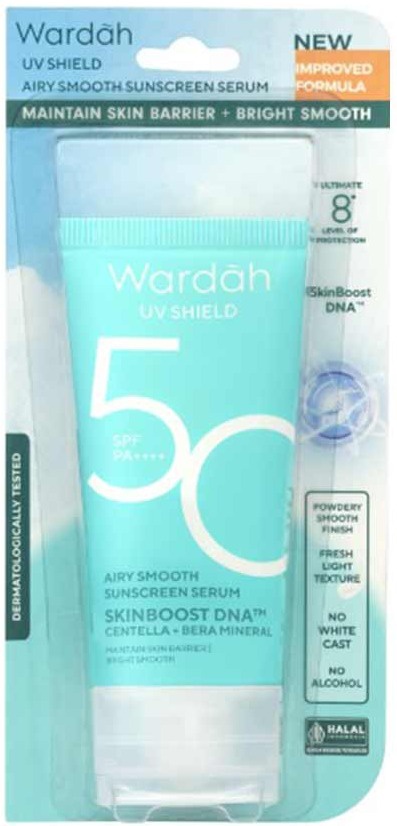
Wardah — UV Shield Airy Sunscreen Serum
Anessa — Mild Care Essence UV SPF 35 PA+++
Purito — Deep Sea Pure Water Cream SPF 50+ PA++++
Storage & shelf life
12 MONTHS12 months after opening. Check the small jar symbol on the packaging for the manufacturer-specified PAO. Some brands also print a manufacture date — keep both in mind.
Store in a cool, dry place away from direct sunlight. Avoid leaving in a hot car or direct heat — sunscreen actives degrade above 35°C / 95°F. Keep the cap on when not in use.
Standard cosmetic packaging with cap. Re-cap after each use to prevent oxidation of actives.
Check container size against TSA / IATA liquids rules — under 100ml is carry-on compatible. Use a leak-proof travel pouch.
Frequently asked questions
FAQYes. Chemical UV filters like ethylhexyl methoxycinnamate are considered safe for topical facial use during pregnancy when applied as directed. The serum format minimizes systemic absorption. However, if you are uncomfortable with any chemical filter, choose a mineral sunscreen instead. Always consult your healthcare provider if you have specific concerns.
This product is not recommended for fungal-acne-prone skin. It contains lecithin and polysorbate 20, both emulsifiers that can feed malassezia yeasts and worsen breakouts in susceptible individuals. If you have a confirmed history of fungal acne (especially if diagnosed by a dermatologist), opt for a mineral-only or fungal-acne-certified sunscreen instead.
Yes. The chemical filter system is stable alongside most actives. In the morning, you can also layer vitamin C before this sunscreen. Allow each product to set before applying the next to prevent pilling.
For optimal protection, apply ¼ teaspoon to your face and neck, or roughly two fingers' width spread across the entire face. Most users under-apply sunscreen, reducing efficacy. If you prefer a lighter feel, apply ½ the amount and reapply more frequently (every 90 minutes instead of 2 hours during outdoor activity). Do not skip application, as even partial coverage leaves sun-exposed patches vulnerable.
Wait 10–15 minutes after application before direct sun exposure. Chemical filters require time to absorb and form a protective matrix on your skin. This timing ensures the filters are fully activated and cannot be easily rubbed off by touching your face or adjusting sunglasses. Plan your morning routine accordingly, especially if you're commuting immediately after skincare.
No. This serum is not water-resistant and will degrade with sweat or water exposure. If you are swimming, exercising, or spending prolonged time at the beach, reapply every 40–80 minutes (as per water-resistance testing standards). For office or casual outdoor use without heavy sweating, reapplication every 2 hours is sufficient.
Chemical sunscreens are typically less visible than mineral filters, and this serum is formulated to be transparent. However, some users with deeper skin tones report a subtle tint if over-applied. Use a lighter layer, blend thoroughly, and wait 2–3 minutes for full absorption to minimize any residue. If white cast is a persistent issue, consider a mineral or tinted sunscreen instead.
UVA rays penetrate ordinary window glass and are the dominant indoor UV exposure. If you spend most of your day near windows (car, desk, retail), apply this sunscreen as part of your morning routine even indoors. For windowless indoor environments (basement office), daily sunscreen is less critical, but many dermatologists recommend it regardless to prevent cumulative photodamage from incidental sun exposure.
Verdict: Wardah UV Shield Airy Sunscreen Serum is a lightweight chemical sunscreen designed for daily facial protection, combining four UV filters with centella asiatica, allantoin, and antioxidant botanicals. The formula excels at delivering broad-spectrum coverage without white cast or greasy residue, making it well-suited for routine wear under makeup on oily and combination skin. Glycerin and a humectant blend prevent the drying sensation typical of chemical filters, supporting daily reapplication without compromising comfort. The serum texture is its strongest asset—fast-absorbing and non-occlusive—but the fragrance and fungal-acne triggers (lecithin, polysorbate 20) limit its audience. The 40ml size is modest for the price, requiring frequent repurchase. There is no listed SPF or PA rating, making it unclear whether it meets global sunscreen standards; this ambiguity may concern users seeking certified protection levels. Best suited for those with oily, combination, or mildly sensitive skin who prioritize lightweight texture, tolerate synthetic fragrance, and want a serum-format sunscreen that doubles as a barrier-repair step alongside their daily routine.
Product Overview

 What are Quick Product Notes?
Quick product notes are a great way to check if a product is free from commonly avoided ingredients by skincare enthusiasts. These preferences come about for different reasons depending on the ingredient such as personal experiences, sensitivities, health preferences & etc.
 Pro Tip Alert!
Just because a product is not free from a common preference does not mean it's a bad product! You can make a personal decision whether or not you want to use a product that contains these ingredients or not - click the labels of the preference to read more about them.
Quick Product Notes
 Paraben-Free
Paraben-Free
Paraben-Free
Understanding Parabens
Parabens are a large group of preservatives which are used to prevent bacteria growing in cosmetic formulations. There has been some healthy controversy surrounding them due to a few studies finding paraben presence in breast tumours and breast tissue. However, the majority of the scientific community have deemed these findings non-conclusive due to the limitations of these studies. There's still a lot of support for avoiding parabens following the better safe than sorry route. If you do we completely support you! If you are concerned about the health safety of parabens, then feel free to avoid them by looking out for the Paraben-Free icon. If not, don't worry about it - they do have had one of the longest safety records as preservatives!
Which Ingredients are classified as Paraben?
A product will be paraben-free if it does not contain any of the following parabens:
- Sodium Isobutylparaben
- Sodium Ethylparaben
- Sodium Butylparaben
- Propylparaben
- Isopropylparaben
- Isobutylparaben
- Sodium Propylparaben
- Butylparaben
- Ethylparaben
- Sodium Methylparaben
- Methylparaben
Sulfate-Free
Sulfate-Free
Understanding Sulfates
Sulfates are a large group of ingredients which act as cleansing agents in Cosmetics. They help loosen up the dirt and grime from your skin and hair to allow for water to wash it away with ease. However some sulfates are so good at their job, they can wash off your skin’s own natural oils that keep it moisturised and protected which can lead to dryness and irritation. Most people will find no issues with sulfate, however if you find your skin doesn't like sulfates then free feel to avoid them by looking out for the sulfate-free icon on Skincarisma.
Which ingredients are classified as sulfates?
We've taken the Sulfates which are considered more harsh for our Sulfate-Free status. A product will be Sulfate-Free if it does not contain any of the following Sulfates:
- TEA-Dodecylbenzenesulfonate
- Ammonium Laureth Sulfate
- Sodium Lauryl Sulfate
- PEG-15 Cocamine
- Sodium Laureth Sulfate
- Sodium Cocoyl Sarcosinate
- Sodium C14-16 Olefin Sulfonate
- Dioctyl Sodium Sulfosuccinate
- Ammonium Xylenesulfonate
- Ammonium Lauryl Sulfate
- Sodium Xylenesulfonate
- Sodium Myreth Sulfate
- Sodium Lauryl Sulfoacetate
Alcohol-Free
Alcohol-Free
Understanding Simple Alcohols
Alcohol ingredients are widely used in cosmetics and come in different types. For the most part alcohols are not problematic at all. However one type of alcohols, simple alcohols can be quite drying to the skin because it evaporates very quickly. This can cause irritation which can also lead to other skin complications. These alcohols should never be used alone on your skin, but combined with other cosmetic ingredients, they are normally without issue. However, for some people with sensitive and easily irritable skin, avoiding products with these simple alcohols may be beneficial. If you find your skin doesn't like these simple alcohols, then free feel to avoid them by looking out for the Alcohol-Free icon.
Which Ingredients are classified as Alcohol?
A product will be alcohol-free if it does not contain any of the following alcohol ingredients:
- SD Alcohol
- Alcohol Denat
- Isopropyl Alcohol
- Alcohol
Silicone-Free
Silicone-Free
Understanding Silicones
If you've ever used a skincare, makeup or beauty product that's made your skin look and feel smoother tempoarily - it's likely contained Silicone. They are a popular class of ingredients found in cosmetics due to their smooth, soft, easy-to-spread and smooth properties that help creates an artificial layer/barrier on top of skin or hair (commonly found in conditioners).
For the same reasons they are popularly used, they are also commonly avoided. Anecdotally, many individuals have reported that Silicones cause/excerbate breakouts, irritation, cause a feeling of skin being unable to breathe, cause clumping of cosmetic products and find it difficult to wash off. As a result, those who find them problematic are avoiding them and increasingly, cosmetic companies are avoiding them as well.
If you have had bad experiences with Silicones in the past, or suspect they are problematic then look out for the tick on the Silicone-free label.
Disclaimer
The Silicone-free label only includes the most common Silicone ingredients that have indentified been reported by individuals that could potentially cause issues.
These include: Amodimethicone, Behenoxy Dimethicone, Bis-Aminopropyl Dimethicone, Cetearyl Methicone, Cetyl Dimethicone, Cyclomethicone, Cyclopentasiloxane, Dimethicone, Dimethicone Copolyol, Dimethiconol, Methicone, Phenyl Trimethicone, Phenyl Trimethicone, Stearoxy Dimethicone, Stearyl Dimethicone, Trimethylsilylamodimethicone.
Note, that this does not include all ingredients part of the Silicone class of ingredients.
EU Allergen-Free
EU Allergen-Free
Understanding the Identified Contact Allergens
The EU's Scientific Committee on Consumer Safety (SCCS) has identified and established 26 cosmetic ingredients that are likely contact allergens (potential to cause skin allergies) as demonstrated in clinical or epidemiological studies. The EU's SCCS have recommend cosmetic companies to disclose them on the labels if used and in cases where the concentration exceeds 0.001% in leave-on products and 0.01% in rinse-off products, then they must be labelled.
Look out for the tick on the EU-Allergen free label to know your cosmetic is free from any of the 26 identified cosmetic ingredients.
For more information regarding the EU's Scientific Committee on Consumer Safety, please visit their official website.
Disclaimer
The EU Allergen Free label is for the 26 ingredients identified by the EU SCCS and products will be only flagged if a suspected ingredient is on it's ingredient list. It is possible for cosmetics to contain one of the suspect ingredients without it appearing on the ingredient list due to it not reaching the concentration threshold to disclose it and cosmetic manufacturers choice to not disclose it.
Also note, the EU Allergen Free label is not personalized for your own allergies you may have and it does not constitute as medical advice. For your specific case, always consult your medical professiona such as dermatologist, physician, pharmacist, or health care provider - please read our medical disclaimer for more information.
Fungal Acne (Molassezia) Safe
Fungal Acne (Molassezia) Safe
Understanding Fungal Acne (Pityrosporum Folliculitis/Malassezia Folliculitis)
Pityrosporum Folliculitis/Malassezia folliculitis or simply known as Fungal Acne is a persistent acne-like condition that commonly responds poorly to traditional acne-treating methods. Unlike most cases of Acne where bacteria is the culprit, Fungi is the culprit of Fungal Acne (Hence the name!). There are certain classes & groups of ingredients that have been shown to promote and feed the growth of the Fungal Acne, Fungi such as fatty acids, oils, esters, polysorbates and fermented ingredients.
For more information regarding Fungal Acne, please visit Simple Skincare Science (f.c) - #3 of our Recommend Skincare Resources for an amazing comprehensive guide!
Please Read: How to use the Fungal Acne (Malassezia) Label
At SkinCarisma, we've done our best to identify as many ingredients as possible but note the fungal-free label may not be 100% accurate due to the complexconditions and combination of ingredients that malezzeria can thrive on.
Additionally, products that may contain ingredients that have shown to feed Malassezia may not neccessarily exacerbate the condition due to concentration of ingredient used in the product, this information is simply not available on the products.
As a result, please note this is only an experimental label that can be best used to possible identify problematic products you have used in the past. It is in no way a perfect identifier nor a predictor in whether or not it will exacerbate or cause fungal acne. It will continue to be worked on as more information and research comes to light.
If you find any ingredients you believe should be included, please email us at snails@skincarisma.com.
Disclaimer
Due to the lack of substantial research into this area it is very likely there are other ingredients and class/groups of ingredients that could feed Fungal Acne which have not been indentified.
The Fungal-Safe label does not constitute as medical advice. For your specific case, always consult your medical professiona such as dermatologist, physician, pharmacist, or health care provider - please read our medical disclaimer for more information.
What are Notable Effects & Ingredients?
Ever used a product that promised a certain effect but provided no results? It might not have contained any notable ingredients that could have been responsible for that promised effect. It doesn't matter what the marketing or packaging «promises» it can do, if it doesn't contain anything that can help - then the likelihood of it helping is low.
We help you identify key notable ingredients that have been shown to help with effects such as acne-fighting, brightening, UV-protection, wound healing & anti-aging to help you achieve your skincare goals smarter. Please note that different notable ingredients have varying levels of research behind them, some are extremely well proven yet some have mixed research in their efficacy.
Pro Tip Alert!
Just because a product doesn't contain any notable ingredients doesn't mean it's bad. And a product with notable ingredients (or even many) doesn't necessarily guarantee the efficacy of the product performing these effects either. There are other factors such as ingredient quality, concentration and formulation that will ultimately determine this.
Be smart and use this as just a starting point for you to make more informed and smarter choices and compare it with reviews to see if the product is right for you
Notable Effects & Ingredients
What are Ingredients Related to Skin Type?
Why are some products great for some people and horrible for others? Well everyone has different skin types and different reactions to the same ingredients.
We've identified a range of ingredients that are commonly regarded as potentially good or bad for those with Dry, Oily/Acne-Prone or Sensitive skin.
Pro Tip Alert!
A product that contains good or bad ingredients for your skin type doesn't always flat out make the entire product good or bad for your skin. There are other factors such as ingredient quality, concentration and formulation that will ultimately determine your skins reaction.
One of the best ways to use this section is to troubleshoot products you've had bad experiences with in the past. Check if it contains any of the marked ingredients to point out suspect ingredients to avoid in the future!
Ingredients Related to Skin Types
 Dry Skin
 Oily/Acne-Prone Skin
 Sensitive Skin
What is the Ingredient Safety Breakdown?
Sensitive Skin
What is the Ingredient Safety Breakdown?
Ingredient Safety Breakdown refers to the percentage % of ingredients in different risk categories as classified by EWG (Environment Working Group) if they are available. There are almost endless cosmetic ingredients and they are one of the few organisations globally that have assigned ratings to a lot of the more commonly used ingredients which is why we reference them.
Pro Tip Alert!
EWG is seen by many to be more on the alarmist side in their assignment of health ratings resulting in rating ingredients as riskier than they actually are. We recommend using this a reference point rather than a strict guide of ingredient safety and to always do further research if into ingredients that you may find suspect.