

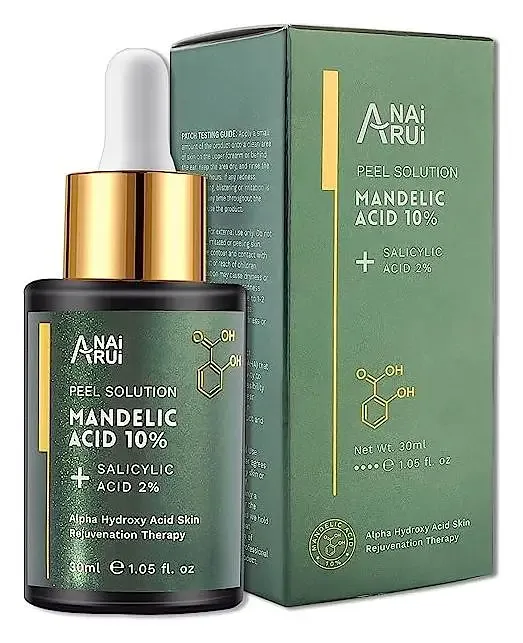
10% Mandelic Acid Serum Peel Solution

Anai Rui

Where to buy Possibly in stock

About this product

The Anai Rui 10% Mandelic Acid Serum Peel Solution is a serums, essence, ampoule. Our analysis of its 19 ingredients (14 low-risk) rates it Excellent (92/100). Based on its ingredients, it looks well-suited to oily / acne-prone and dry skin.

Vegan-friendly Reef-safe

Summarised from our ingredient analysis — not brand marketing copy.

At a glance

Type
Serums, Essence, Ampoules
Ingredients
19
Low-risk
14
Fragrance
Fragrance-free
Origin
Hong Kong
Data updated
Jun 2026

The evidence

Quick Product Notes

Paraben-Free Sulfate-Free Alcohol-Free Silicone-Free EU Allergen-Free Fungal Acne (Malassezia) Safe

Notable Effects & Ingredients

No Notable Effects & Ingredients

Ingredients Related to Skin Types

Good   Bad — tap a skin type to see which ingredients · estimated from ingredient functions
Dry Skin 4/2
Good for dry skin
Glyceryl Caprylate Saccharide Isomerate Isononyl Isononanoate Hyaluronic Acid
Caution for dry skin
Glyceryl Caprylate Salicylic Acid
Oily/Acne-Prone Skin 2/0
Good for oily/acne-prone skin
Salicylic Acid Retinol
Sensitive Skin 1/3
Good for sensitive skin
Tocopheryl Acetate
Caution for sensitive skin
Salicylic Acid Acacia Senegal Gum Retinol

Ingredients list

19 total
Lower hazard (1) Higher hazard (9)
All19 Skin Conditioning17 Solvent3 Hair Conditioning3 Emollient2 Humectant2 Antistatic Agent2 Antioxidant2 Masking2
EWG CIR Ingredient Name & Cosmetic Functions Notes
1
Water
(Solvent)
1
Mandelic Acid
(Antimicrobial)
1
A
Niacinamide
(Hair Conditioning, Skin Conditioning, Smoothing)
SIMMONDSIA CHINENSIS SEED OIL
(Hair Conditioning, Skin Conditioning, Skin Conditioning Emollient)
1
Oligopeptide-1
(Skin Conditioning)
1
Portulaca Oleracea Extract
(Skin Conditioning)
4
B
Salicylic Acid
(Antiacne Agent, Antidandruff Agent, Corn/Callus/Wart Remover, Denaturant, Exfoliant, Fragrance, Hair Conditioning, Skin Conditioning, Keratolytic, Masking, Preservative)
Good for Oily Skin
Good for Oily Skin
Bad for Sensitive Skin
3
A
Acacia Senegal Gum
(Adhesive, Fragrance, Film Forming, Masking)
Melaleuca Alternifolia Leaf Oil
(Antioxidant, Perfuming)
1
A
Hyaluronic Acid
(Skin Conditioning, Viscosity Increasing Agent, Antistatic Agent, Humectant, Moisturising)
3
Tocopheryl Acetate
(Antioxidant, Skin Conditioning)
Bad for Oily Skin
Bad for Oily Skin
3-O-ETHYL ASCORBIC ACID
(Skin Conditioning)
1
B
Isononyl Isononanoate
(Skin Conditioning, Emollient, Antistatic Agent)
9
A
Retinol
(Skin Conditioning)
Bad for Sensitive Skin
1
Saccharide Isomerate
(Humectant)
1
Caprylhydroxamic Acid
(Chelating Agent)
1
A
Glyceryl Caprylate
(Skin Conditioning, Emollient, Emulsifying, Surfactant)
1
A
Pentylene Glycol
(Skin Conditioning, Solvent)
1
A
1,2-Hexanediol
(Solvent)

My Ingredient Notes

No personal ingredient notes yet. Save ingredients to your profile to get good/bad alerts here.

Browse similar serums, essence, ampoule
No close formula match yet — browse other products like this

Key ingredients

Antioxidants
Shields skin from free radical damage.
AHA
Exfoliates skin for a brighter complexion.
BHA
Unclogs pores and reduces excess oil.
Retinoid
Visibly reduces the signs of aging.
Vitamin C
Brightens, evens tone, and supports collagen.
Vitamin E
Protects skin and soothes irritation.
Niacinamide
Strengthens, smooths, and brightens skin.
Hyaluronic Acid
Hydrates by attracting and holding water.

Benefits

BrighteningRestores radiance to dull, tired skin.
Scar HealingImproves the look of marks and scars.
Acne FightingFights acne and helps prevent breakouts.
HydratingBoosts hydration and relieves dry, tight skin.
Good For Oily SkinBalances oil and helps reduce shine.
Reduces Large PoresMinimizes the look of enlarged pores.
Skin TextureSmooths rough patches and refines texture.
Barrier RepairStrengthen and restore your skin's natural barrier.

Concerns

Retinol — higher EWG
May not suit sensitive skin

EWG flags hazard, not real-world risk — ratings don't account for how much of an ingredient a product contains. Treat these as things to research, not verdicts. How we score →

Ingredients explained

Water
Solvent
Low-hazard ingredient.Read moreShow less
EWG 1 Solvent
Mandelic Acid
Antimicrobial
Low-hazard ingredient.Read moreShow less
EWG 1 Antimicrobial
Niacinamide
Hair conditioning, Skin conditioning
Low-hazard ingredient.Read moreShow less
EWG 1 CIR A Hair conditioningSkin conditioningSmoothing
SIMMONDSIA CHINENSIS SEED OIL
Hair conditioning, Skin conditioning
Limited public safety data.Read moreShow less
EWG N/A Hair conditioningSkin conditioningSkin conditioning emollient
Oligopeptide-1
Skin conditioning
Low-hazard ingredient.Read moreShow less
EWG 1 Skin conditioning
Portulaca Oleracea Extract
Skin conditioning
Low-hazard ingredient.Read moreShow less
EWG 1 Skin conditioning
Acacia Senegal Gum
Adhesive, Fragrance
Low-to-moderate hazard.Read moreShow less
EWG 3 CIR A AdhesiveFragranceFilm formingMasking
Melaleuca Alternifolia Leaf Oil
Antioxidant, Perfuming
Limited public safety data.Read moreShow less
EWG N/A AntioxidantPerfuming
Hyaluronic Acid
Skin conditioning, Viscosity increasing agent
Low-hazard ingredient.Read moreShow less
EWG 1 CIR A Skin conditioningViscosity increasing agentAntistatic agentHumectantMoisturising
3-O-ETHYL ASCORBIC ACID
Skin conditioning
Limited public safety data.Read moreShow less
EWG N/A Skin conditioning
Isononyl Isononanoate
Skin conditioning, Emollient
Low-hazard ingredient.Read moreShow less
EWG 1 CIR B Skin conditioningEmollientAntistatic agent
Saccharide Isomerate
Humectant
Low-hazard ingredient.Read moreShow less
EWG 1 Humectant
Caprylhydroxamic Acid
Chelating agent
Low-hazard ingredient.Read moreShow less
EWG 1 Chelating agent
Glyceryl Caprylate
Skin conditioning, Emollient
Low-hazard ingredient.Read moreShow less
EWG 1 CIR A Skin conditioningEmollientEmulsifyingSurfactant
Pentylene Glycol
Skin conditioning, Solvent
Low-hazard ingredient.Read moreShow less
EWG 1 CIR A Skin conditioningSolvent
+ 1 more — see the full ingredients list above
Salicylic Acid
Antiacne agent, Antidandruff agent
Skin irritation can occur at high concentrationRead moreShow less
EWG 4 CIR B Antiacne agentAntidandruff agentCorn/callus/wart removerDenaturantExfoliantFragranceHair conditioningSkin conditioningKeratolyticMaskingPreservative Good for Oily SkinBad for Sensitive Skin
Tocopheryl Acetate
Antioxidant, Skin conditioning
Potentially comedogenic - can block poresRead moreShow less
EWG 3 AntioxidantSkin conditioning Bad for Oily Skin
Retinol
Skin conditioning
Potentially a skin irritantRead moreShow less
EWG 9 CIR A Skin conditioning Bad for Sensitive Skin

How to use

How to use

  • 1 Where it fits: Apply after toner and before moisturiser — thinnest to thickest.
  • 2 Evening: Use at night — start 2–3× a week and build up as your skin tolerates it.
  • 3 Wear SPF the next day: Acids and retinoids increase sun sensitivity — daily sunscreen is a must while using this.

General guidance from this product's category and active ingredients — always follow the directions on the package.

Trust & honesty

Pregnancy & breastfeeding

Contains ingredients some choose to avoid or double-check while pregnant or nursing.

Often avoided
Retinoids (Vitamin A) (Retinol)

Topical retinoids (retinol, retinaldehyde, retinyl esters) are widely advised against in pregnancy as a precaution. The strongest evidence is for ORAL retinoids; topical absorption is low, but most clinicians err on the side of caution.

Use with caution
BHA (salicylic) (Salicylic Acid)

Low-strength topical salicylic acid (BHA) is generally considered fine. Caution is usually reserved for high-strength leave-on products and salicylic peels.

This is general information, not medical advice. Pregnancy guidance varies and depends on concentration and your individual situation — always check with your doctor, midwife or pharmacist. How we flag this.

Effective levels — general guide

The concentrations these actives are typically effective at in research — not a measurement of this product.

Retinoids (Vitamin A) 0.01–1%

Most studied between 0.1% and 1%. Higher is not automatically better — irritation climbs with dose, so a well-formulated lower strength is often the sweet spot.

Retinol

Vitamin C (ascorbic) 5–20%

L-ascorbic acid is usually used at 5–20% (around 10–15% is common). Above ~20% adds little and tends to irritate more; it also needs a low pH to work.

3-O-ETHYL ASCORBIC ACID

Niacinamide 2–5% (up to 10%)

Most research uses 2–5%; some formulas go to 10%. Very high levels can cause flushing in sensitive skin.

Niacinamide

BHA (salicylic) 0.5–2%

Salicylic acid is OTC-capped at 2%; 0.5–2% is the usual leave-on range. Much below that it acts more as a soothing agent than an exfoliant.

Salicylic Acid

AHA (acid exfoliant) 5–10% (OTC)

OTC leave-on AHAs are usually 5–10%. The effect also depends on pH and free-acid value, not the percentage alone.

Mandelic Acid

INCI lists don't disclose amounts, and we don't claim to know this product's levels — these are the ranges these ingredients are usually effective at, so you can tell a real formula from "fairy-dusting" a marketed active. How we estimate this.

From the community

0
Reviews
0
Saved by users
0
In collections

Ratings & reviews

Write a Review
0.0
from 0 ratings

Used this product? Rate it in 10 seconds

Alternatives