

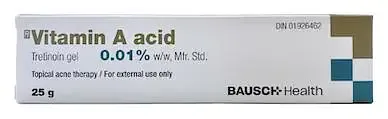
Vitamin A Acid Tretinoin Gel 0.01

Bausch Health

Vitamin A Acid Tretinoin Gel 0.01

0.0
from 0 Ratings
Where to buy Possibly in stock

About this product

The Bausch Health Vitamin A Acid Tretinoin Gel 0.01 is a misc. Our analysis of its 11 ingredients (6 low-risk) rates it Great (74/100). Based on its ingredients, it looks well-suited to oily / acne-prone skin.

Vegan-friendly Reef-safe

Summarised from our ingredient analysis — not brand marketing copy.

At a glance

Type
Misc
Ingredients
11
Low-risk
6
Fragrance
Fragrance-free
Origin
Canada
Data updated
May 2026

The evidence

Quick Product Notes

Paraben-Free Sulfate-Free Alcohol-Free Silicone-Free EU Allergen-Free Fungal Acne (Malassezia) Safe Minimal Ingredients

Notable Effects & Ingredients

No Notable Effects & Ingredients

Ingredients Related to Skin Types

Good   Bad — tap a skin type to see which ingredients · estimated from ingredient functions
Dry Skin 1/2
Good for dry skin
Propylene Glycol
Caution for dry skin
Alcohol Triethanolamine
Oily/Acne-Prone Skin 2/0
Good for oily/acne-prone skin
Alcohol Retinol
Sensitive Skin 0/8
Caution for sensitive skin
Propylene Glycol Triacetin Alcohol Isopropyl Alcohol Methylparaben Triethanolamine Propylparaben Retinol

Ingredients list

11 total
Lower hazard (1) Higher hazard (9)
All11 Fragrance6 Solvent5 Viscosity Controlling3 Masking3 Preservative2 Humectant2 Perfuming2 Viscosity Decreasing Agent2
EWG CIR Ingredient Name & Cosmetic Functions Notes
9
A
Retinol
(Skin Conditioning)
Bad for Sensitive Skin
1
A
Triacetin
(Cosmetic Biocide, Fragrance, Plasticizer, Solvent, Antimicrobial, Film Forming, Masking)
2
Alcohol
(Antifoaming Agent, Antimicrobial, Astringent, Masking, Solvent, Viscosity Controlling)
Bad for Dry Skin
Bad for Dry Skin
Bad for Sensitive Skin
PEG-800/Polyvinyl Alcohol Copolymer
(Film Forming, Hair Fixing)
2
A
Isopropyl Alcohol
(Antifoaming Agent, Fragrance, Solvent, Viscosity Decreasing Agent, Perfuming, Viscosity Controlling)
Bad for Sensitive Skin
3
B
Propylene Glycol
(Fragrance, Humectant, Skin Conditioningagent Miscellaneous, Solvent, Viscosity Decreasing Agent, Skin Conditioning, Viscosity Controlling)
Good for Dry Skin
Good for Dry Skin
1
Water
(Solvent)
2
A
Tetrasodium EDTA
(Chelating Agent)
5
B
Triethanolamine
(Fragrance, Ph Adjuster, Emulsifying, Surfactant, Buffering Agent, Masking)
4
A
Methylparaben
(Fragrance, Preservative)
Paraben
Paraben
7
A
Propylparaben
(Fragrance, Preservative, Perfuming)
Paraben
Paraben

My Ingredient Notes

No personal ingredient notes yet. Save ingredients to your profile to get good/bad alerts here.

Browse similar misc
No close formula match yet — browse other products like this

Key ingredients

Retinoid
Visibly reduces the signs of aging.

Benefits

Acne FightingFights acne and helps prevent breakouts.
Anti-AgingSoftens lines and helps skin look youthful.
BrighteningRestores radiance to dull, tired skin.
Reduces Large PoresMinimizes the look of enlarged pores.
Scar HealingImproves the look of marks and scars.
Dark SpotsFades dark spots for even skin tone.
Skin TextureSmooths rough patches and refines texture.
HydratingBoosts hydration and relieves dry, tight skin.

Concerns

Contains paraben
Retinol — higher EWG
Propylparaben — higher EWG
May not suit dry skin
May not suit sensitive skin

EWG flags hazard, not real-world risk — ratings don't account for how much of an ingredient a product contains. Treat these as things to research, not verdicts. How we score →

Ingredients explained

Triacetin
Cosmetic biocide, Fragrance
Low-hazard ingredient.Read moreShow less
EWG 1 CIR A Cosmetic biocideFragrancePlasticizerSolventAntimicrobialFilm formingMasking
PEG-800/Polyvinyl Alcohol Copolymer
Film forming, Hair fixing
Limited public safety data.Read moreShow less
EWG N/A Film formingHair fixing
Water
Solvent
Low-hazard ingredient.Read moreShow less
EWG 1 Solvent
Tetrasodium EDTA
Chelating agent
Low-hazard ingredient.Read moreShow less
EWG 2 CIR A Chelating agent
Retinol
Skin conditioning
Potentially a skin irritantRead moreShow less
EWG 9 CIR A Skin conditioning Bad for Sensitive Skin
Alcohol
Antifoaming agent, Antimicrobial
Causes moisture evaporation - prone to dry out skinRead moreShow less
EWG 2 Antifoaming agentAntimicrobialAstringentMaskingSolventViscosity controlling Bad for Dry SkinBad for Sensitive Skin
Isopropyl Alcohol
Antifoaming agent, Fragrance
Low-hazard ingredient.Read moreShow less
EWG 2 CIR A Antifoaming agentFragranceSolventViscosity decreasing agentPerfumingViscosity controlling Bad for Sensitive Skin
Propylene Glycol
Fragrance, Humectant
Low-to-moderate hazard.Read moreShow less
EWG 3 CIR B FragranceHumectantSkin-conditioningagent - miscellaneousSolventViscosity decreasing agentSkin conditioningViscosity controlling Good for Dry Skin
Triethanolamine
Fragrance, Ph adjuster
Moderate-hazard ingredient.Read moreShow less
EWG 5 CIR B FragrancePh adjusterEmulsifyingSurfactantBuffering agentMasking
Methylparaben
Fragrance, Preservative
Low-to-moderate hazard.Read moreShow less
EWG 4 CIR A FragrancePreservative Paraben
Propylparaben
Fragrance, Preservative
Higher-hazard ingredient.Read moreShow less
EWG 7 CIR A FragrancePreservativePerfuming Paraben

How to use

How to use

  • 1 Evening: Use at night — start 2–3× a week and build up as your skin tolerates it.
  • 2 Wear SPF the next day: Acids and retinoids increase sun sensitivity — daily sunscreen is a must while using this.

General guidance from this product's category and active ingredients — always follow the directions on the package.

Trust & honesty

Pregnancy & breastfeeding

Contains ingredients some choose to avoid or double-check while pregnant or nursing.

Often avoided
Retinoids (Vitamin A) (Retinol)

Topical retinoids (retinol, retinaldehyde, retinyl esters) are widely advised against in pregnancy as a precaution. The strongest evidence is for ORAL retinoids; topical absorption is low, but most clinicians err on the side of caution.

This is general information, not medical advice. Pregnancy guidance varies and depends on concentration and your individual situation — always check with your doctor, midwife or pharmacist. How we flag this.

Effective levels — general guide

The concentrations these actives are typically effective at in research — not a measurement of this product.

Retinoids (Vitamin A) 0.01–1%

Most studied between 0.1% and 1%. Higher is not automatically better — irritation climbs with dose, so a well-formulated lower strength is often the sweet spot.

Retinol

INCI lists don't disclose amounts, and we don't claim to know this product's levels — these are the ranges these ingredients are usually effective at, so you can tell a real formula from "fairy-dusting" a marketed active. How we estimate this.

From the community

0
Reviews
0
Saved by users
0
In collections

Ratings & reviews

Write a Review
0.0
from 0 ratings

Used this product? Rate it in 10 seconds

Alternatives