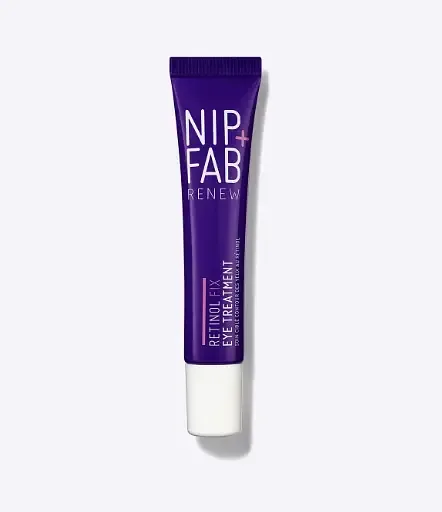




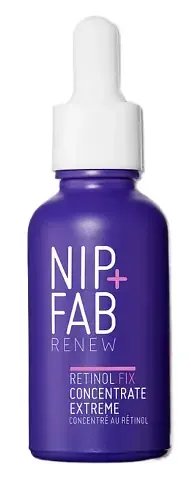
Retinol Fix Concentrate Extreme 10%
The Nip + Fab Retinol Fix Concentrate Extreme 10% is a serums, essence, ampoule. Our analysis of its 28 ingredients (16 low-risk) rates it Excellent (82/100). Based on its ingredients, it looks well-suited to oily / acne-prone and dry skin. Heads up: it contains fragrance, which can irritate sensitive or reactive skin.
The Nip + Fab Retinol Fix Concentrate Extreme 10% is a serums, essence, ampoule. Our analysis of its 28 ingredients (16 low-risk) rates it Excellent (82/100). Based on its ingredients, it looks well-suited to oily / acne-prone and dry skin. Heads up: it contains fragrance, which can irritate sensitive or reactive skin.
Summarised from our ingredient analysis — not brand marketing copy.
The evidence
 Dry Skin
5/4
Dry Skin
5/4
 Oily/Acne-Prone Skin
1/0
Oily/Acne-Prone Skin
1/0
 Sensitive Skin
3/12
Sensitive Skin
3/12
| EWG | CIR | Ingredient Name & Cosmetic Functions | Notes |
|---|---|---|---|
 1
1
|

|
Water
(Solvent) |
|
|
3
|
 B
B
|
Polysorbate 20
(Emulsifying, Surfactant) |

Fungal Acne Trigger
|
|
2
|
 A
A
|
Glycerin
(Denaturant, Fragrance, Hair Conditioning, Humectant, Oral Care Agent, Oral Health Care Drug, Skin Protecting, Viscosity Decreasing Agent, Perfuming, Solvent) |

Good for Dry Skin
Fungal Acne Trigger
|
|
1
|
A
|
Caprylic/Capric Triglyceride
(Emollient, Masking, Perfuming, Skin Conditioning, Solvent) |
|
 4
4
|
A
|
Phenoxyethanol
(Fragrance, Preservative) |

Paraben
|
 9
9
|
A
|
Retinol
(Skin Conditioning) |

Bad for Sensitive Skin
|
|
1
|
A
|
Hydroxypropyl Cyclodextrin
(Chelating Agent, Emulsion Stabilising, Masking, Skin Conditioning) |
|
|
1
|
A
|
Butylene Glycol
(Fragrance, Skin Conditioning, Solvent, Viscositydecreasing Agent, Humectant, Masking, Viscosity Controlling) |
Good for Dry Skin
|
|
5
|
A
|
Benzyl Alcohol
(External Analgesic, Fragrance, Oral Health Care Drug, Preservative, Solvent, Viscosity Decreasing Agent, Masking) |

Allergens
|
|
1
|
A
|
Xanthan Gum
(Binding Agent, Emulsion Stabilising, Skin Conditioning, Surfactant Emulsifying Agent, Viscosity Increasing Agent, Binding, Gel Forming, Viscosity Controlling) |
|

|
|
PARFUM
(Fragrance, Perfuming) |
|
|
1
|
|
Bakuchiol
(Cosmetic Biocide, Antimicrobial) |
|
|
|
|
Bisabolol
(Fragrance, Skin Conditioning, Soothing) |
|
|
1
|
A
|
Palmitoyl Tripeptide-1
(Skin Conditioning) |
|
|
1
|
A
|
Palmitoyl Tetrapeptide-7
(Skin Conditioning) |
|
|
1
|
A
|
Disodium EDTA
(Chelating Agent, Viscosity Controlling) |
|
|
4
|
A
|
Sodium Metabisulfite
(Antioxidant, Preservative, Reducing) |
|
|
|
|
TOCOPHEROL
(Antioxidant, Fragrance, Skin Conditioning) |
|
|
1
|
A
|
Hyaluronic Acid
(Skin Conditioning, Viscosity Increasing Agent, Antistatic Agent, Humectant, Moisturising) |
|
|
1
|
A
|
Dehydroacetic Acid
(Preservative) |
|
|
3
|
B
|
Sodium Hydroxide
(Denaturant, Ph Adjuster, Buffering Agent) |
|
|
6
|
A
|
BHT
(Antioxidant, Fragrance, Masking) |
|
|
1
|
A
|
Carbomer
(Emulsion Stabilising, Viscosity Increasing Agent, Gel Forming, Viscosity Controlling) |
|
|
3
|
B
|
Sodium Lactate
(Buffering Agent, Exfoliant, Humectant, Keratolytic) |
|
|
7
|
|
Benzyl Salicylate
(Fragrance, Uv Absorber, Masking) |
Allergens
|
|
5
|
|
Hexyl Cinnamal
(Fragrance, Masking) |
Allergens
|
|
6
|
|
Limonene
(Deodorant, Perfuming, Solvent) |
Allergens
|
|
5
|
|
Linalool
(Fragrance, Deodorant, Masking) |
Allergens
|
No personal ingredient notes yet. Save ingredients to your profile to get good/bad alerts here.
EWG flags hazard, not real-world risk — ratings don't account for how much of an ingredient a product contains. Treat these as things to research, not verdicts. How we score →
How to use
General guidance from this product's category and active ingredients — always follow the directions on the package.
Trust & honesty
Contains ingredients some choose to avoid or double-check while pregnant or nursing.
Topical retinoids (retinol, retinaldehyde, retinyl esters) are widely advised against in pregnancy as a precaution. The strongest evidence is for ORAL retinoids; topical absorption is low, but most clinicians err on the side of caution.
This is general information, not medical advice. Pregnancy guidance varies and depends on concentration and your individual situation — always check with your doctor, midwife or pharmacist. How we flag this.
The concentrations these actives are typically effective at in research — not a measurement of this product.
Most studied between 0.1% and 1%. Higher is not automatically better — irritation climbs with dose, so a well-formulated lower strength is often the sweet spot.
Retinol
INCI lists don't disclose amounts, and we don't claim to know this product's levels — these are the ranges these ingredients are usually effective at, so you can tell a real formula from "fairy-dusting" a marketed active. How we estimate this.
From the community
Used this product? Rate it in 10 seconds
Alternatives
Other products people analyze alongside this one.